下一站幸福
China blasts Japanese politicians paying respects to Yasukuni war shrine on 81st anniversary of its unconditional surrender_我的网站

A |
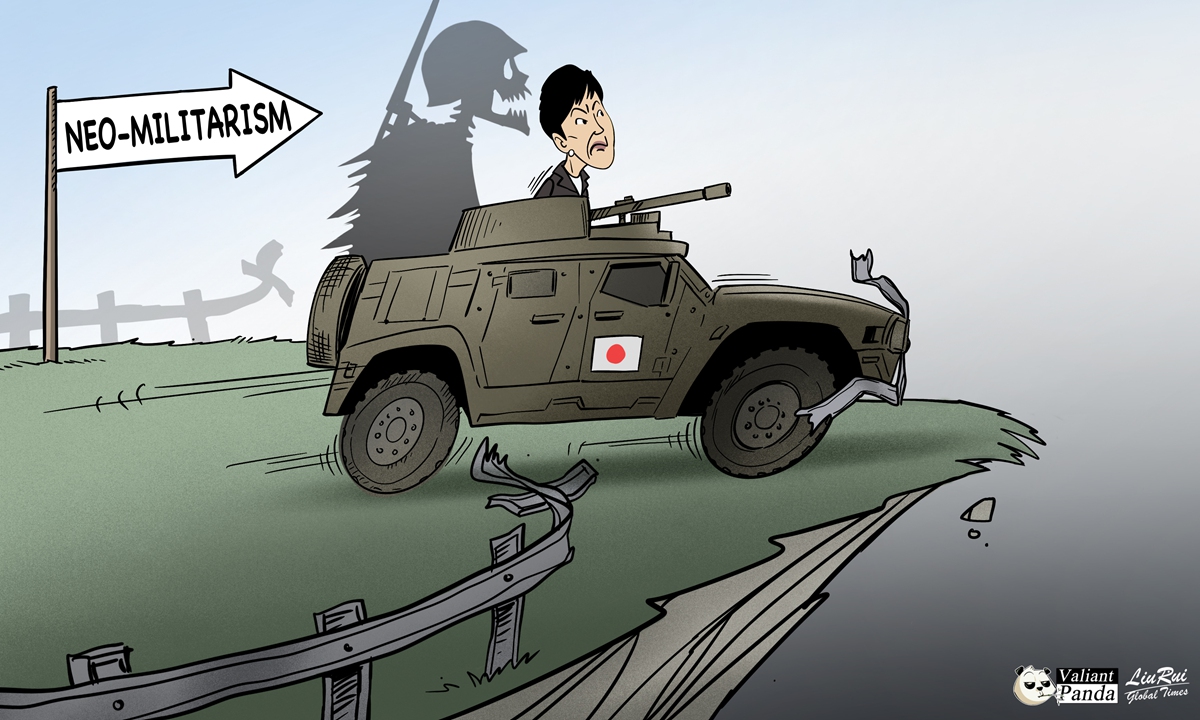
Illustration: Liu Rui/GT
China strongly deplores Japan's negative moves related to the Yasukuni war shrine, and has lodged serious protests against Japan, a Chinese Foreign Ministry (FM) spokesperson said in a statement on Saturday, in response to Japanese politicians paying respects to the Yasukuni war shrine, which honors Class-A war criminals, on the 81st anniversary of Japan's unconditional surrender in World War II.
On such a sensitive day, Japanese Prime Minister Sanae Takaichi sent a ritual offering to the notorious Yasukuni shrine, while Defense Minister Shinjiro Koizumi and several senior executives of the ruling Liberal Democratic Party (LDP) visited in person, prompting Chinese experts to warn that Japan's increasingly brazen moves signal a dangerous shift toward neo-militarism.
Takaichi made a "tamagushi" ritual offering to the notorious shrine using her private funds in her capacity as LDP president, Japan's Kyodo News reported Saturday, citing LDP Secretary-General Shunichi Suzuki. Takaichi did not visit the shrine in person. Koizumi, however, visited the notorious shrine Saturday morning. Hitoshi Kikawada, a member of Takaichi's Cabinet, also visited the shrine.
Meanwhile, Suzuki, LDP General Council Chairperson Haruko Arimura and Election Strategy Committee Chairperson Yasutoshi Nishimura visited the shrine together on Saturday, according to Kyodo News and the Xinhua News Agency.
Japan's Mainichi Shimbun on Saturday described the collective August 15 visit by senior LDP executives as "unusual."
Chinese media including state broadcaster CCTV reported that it marked the first collective visit to the shrine by senior LDP executives.
Yasukuni Shrine, located in central Tokyo's Chiyoda Ward, honors 14 convicted Japanese Class-A war criminals from World War II. It has long been a source of diplomatic friction between Japan and its neighbors. For a long time, visits and ritual offerings made by Japanese officials to the controversial shrine have consistently sparked criticism and opposition both at home and abroad, hurting the feelings of the people of China, South Korea, and other countries and regions victimized by Japan's wartime aggression, according to Xinhua.
An affront to historical justice"No pretext whatsoever can hide the Japanese politicians' true intention which is to change the verdict on the war criminals, cover up Japan's war crimes, distort the historical facts, and pave the way for accelerating remilitarization. This is an affront to historical justice, a challenge to the foundational norms of civilization, and a provocation against the postwar international order. Such behaviors have been firmly rejected by the overwhelming majority of the international community," the Chinese FM spokesperson's statement said on Saturday.
This year marks the 80th anniversary of the opening of the Tokyo Trials. To view and treat history correctly is an important prerequisite for Japan's postwar return to the international community, the political foundation for Japan's ties with neighboring countries, and more importantly, a key measure for Japan's commitment to peaceful development, the statement noted.
"We urge the Japanese side to do serious soul-searching on its history of aggression, make a clean break with militarism, and earn trust from its Asian neighbors and the rest of the world with concrete actions," the spokesperson said.
Lü Chao, an expert on East Asian studies and a professor at the Liaoning Academy of Social Sciences, told the Global Times on Saturday that attitudes toward the notorious Yasukuni shrine on this very day have long served as an important "touchstone" for the international community to judge whether Japanese political forces genuinely recognize the country's wartime aggression and responsibility.
"What is particularly alarming this year is how openly these political signals are being sent," Lü said. "The combination of an offering by the prime minister, a visit by the sitting defense minister and a coordinated appearance by senior ruling-party executives means the issue can hardly be dismissed merely as individual acts of mourning."
Although Takaichi stayed away in person, Lü said the offering still clearly demonstrated her political attitude. "Not visiting personally does not fundamentally change the political nature of the gesture," Lü said, noting that diplomatic and domestic pressure may have affected the form Takaichi chose, but not necessarily her underlying position.
Particular attention required"The collective actions of senior figures in the ruling party deserve particular attention," he said. "They raise the question of whether Japan's political establishment has truly developed a correct understanding of its aggression and wartime crimes."
Chinese military affairs expert Song Zhongping told the Global Times on Saturday that visits by Japanese conservative lawmakers and government officials to the notorious shrine are not new and should not be treated as an isolated development unique to the Takaichi administration.
Former prime minister Junichiro Koizumi repeatedly visited the shrine and went there as prime minister on August 15, 2006. Shinzo Abe visited as sitting prime minister in December 2013. Shinjiro Koizumi himself visited on August 15, 2025, when he was agriculture minister.
"The important point is that this tendency has persisted within Japanese right-wing politics for decades," Song said. "What we are seeing now is not its sudden emergence, but its increasingly overt expression."
Song further noted that the political significance of Koizumi's visit is amplified by his current position as defense minister. "A defense minister's understanding of wartime history cannot simply be regarded as a private attitude," he said. "It inevitably leads people to ask what kind of direction Japan's defense policy and Self-Defense Forces may take."
Such concern comes as the Takaichi government pushes to strengthen Japan's military capabilities and pursue constitutional revision.
Song stressed that Japan has already expanded defense spending, developed so-called counterstrike capabilities and eased restrictions on defense equipment transfers under the existing Constitution, meaning constitutional revision should not inaccurately be portrayed as a legal prerequisite for all such measures.
What deserves greater scrutiny, he said, is whether historical revisionism, constitutional revision and military expansion are increasingly reinforcing one another.
"The issue surrounding the notorious Yasukuni Shrine is not simply one of mourning," Song said. "When political forces refuse to squarely confront the history of aggression while simultaneously seeking greater military capabilities and fewer postwar restraints, neighboring countries have every reason to remain vigilant."
。

B | 国家竞争监管机构今天表示,它将调查Booking.com的某些做法是否构成在向酒店提供中介服务方面滥用支配地位--因此,它是否对位于西班牙的酒店施加了不公平的交易条件,并实施了可能对其他在线旅行社和在线销售渠道产生排斥作用的商业政策。西班牙国家市场和竞争委员会(CNMC)还表示,它将调查Booking.com的行为是否包括构成对西班牙酒店经济依赖地位的利用--因此,正如其新闻稿中所说,"由于其产生的自由竞争的扭曲而构成影响公共利益的不公平竞争行为"。"在审查了收到的投诉和在初步调查中收集的信息后,CNMC的竞争局认为有理由支持Booking.com B.V.可能违反了SCA[西班牙竞争法]第2和第3条以及TFEU[欧盟运作条约]第102条,"CNMC补充说。西班牙监督机构有18个月的时间来进行调查并作出最终决定,它还指出,正式程序的启动并不预示着最终结果。Booking.com是第一波互联网创业公司中的老将,其在旅游领域的市场实力长期以来一直是欧盟立法者关注的问题--这显然有助于迫使该集团最近重新启动更严格的反垄断制度,该制度将于明年开始实施。Booking.com有可能被指定为泛欧盟数字市场法案(DMA)下的守门人--这将触发对其核心平台服务的事前监管,要求其区域业务遵守一套前期运营措施和条件,旨在确保与依赖该平台接触自己客户的其他企业公平交易。然而,DMA不太可能在明年立即加速行动,因为随着委员会加紧履行监管大科技的新角色,指定守门人的过程将需要几个月(甚至很多个月)。

C | 这意味着,在此同时,以欧盟内国家为单位的竞争调查--比如西班牙国家竞争委员会今天宣布的调查必须填补这一空白。

D | 在这种情况下,依靠既定的(较慢的)竞争监管工具,通常需要在任何干预之前对投诉进行强有力的调查--这一过程可能需要数年才能做出任何必要的纠正命令。
Current article:http://9a0.runtunpaixufenjuduishuang.pics/fhl/20260826/967843.html
Published on:01:46:48


